



Choosing patients for Lu-PSMA: PSMA PET volume, SUVmean and ctDNA
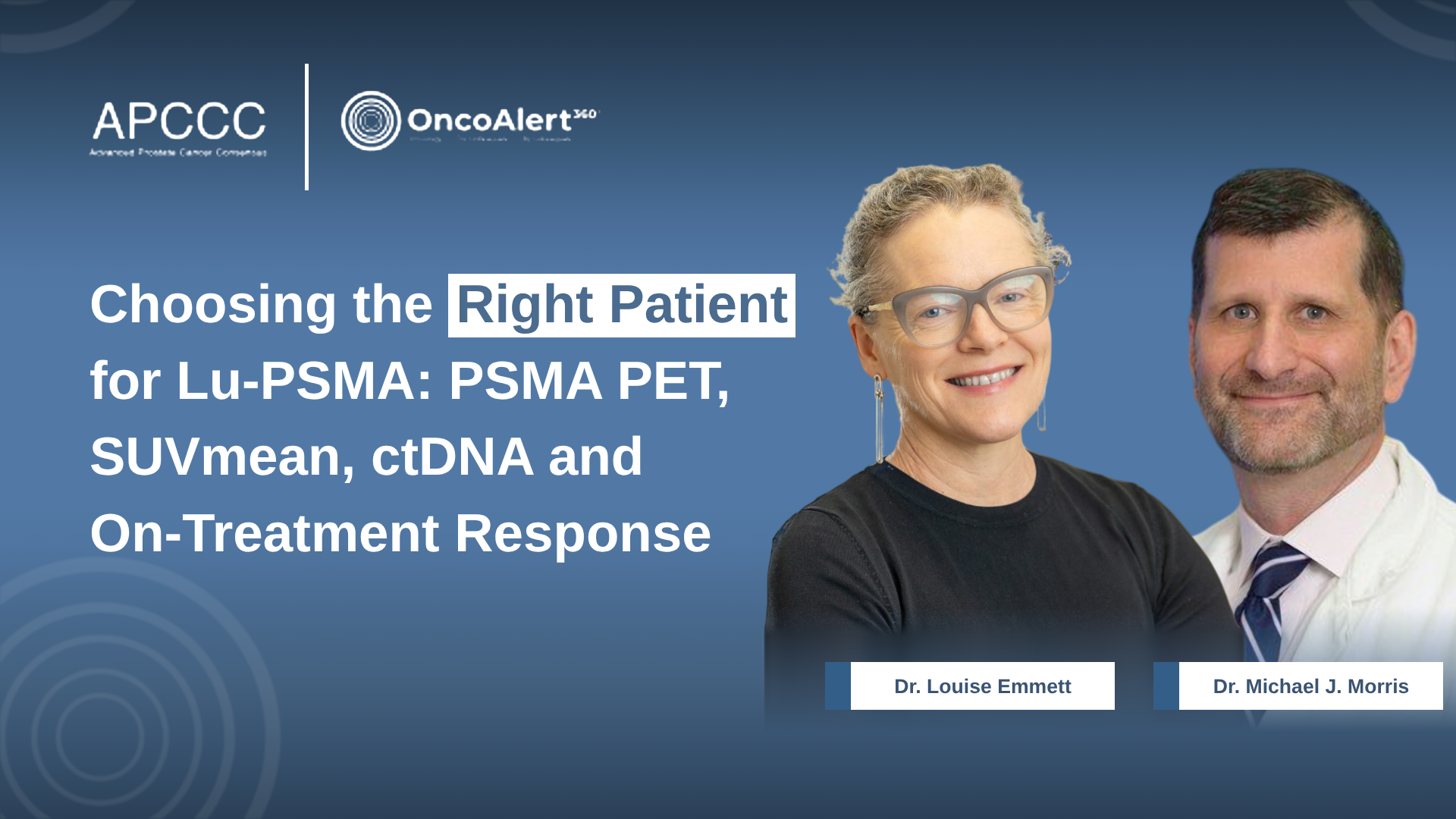
Tumor volume and SUVmean on PSMA PET are the most promising markers for choosing patients, with ctDNA a possible marker of radiation resistance. By six weeks, imaging and ctDNA can flag disease that is not responding.
Dr. Louise Emmett (St Vincent's Hospital Sydney, Australia) and Dr. Michael J. Morris (Memorial Sloan Kettering Cancer Center, USA) discuss how to select the right patients for Lu-PSMA radioligand therapy.
Before treatment, the most promising biomarkers are tumor volume and SUVmean on PSMA PET, plus ctDNA as a possible marker of radiation resistance. In ENZA-p, high-volume disease predicted benefit from adding Lu-PSMA to enzalutamide, with overall survival rising from 20 to 28 months. Patients with low-volume disease saw no difference.
Response during treatment matters too. By six weeks, rising disease volume on SPECT or PET, or ctDNA that hasn't cleared, can flag radiation-resistant disease early. That opens the option of escalating to an alpha emitter, switching to chemotherapy, or pausing treatment in exceptional responders. The conversation also covers how progression on PSMA PET at three months identified patients with poor outcomes regardless of treatment, and its role in PCWG4.
In this discussion
- Tumor volume and SUVmean on PSMA PET before treatment
- ENZA-p: high-volume disease, and overall survival from 20 to 28 months
- ctDNA as a possible marker of radiation resistance
- Reading the response by six weeks: an alpha emitter, chemotherapy or a pause
- Progression on PSMA PET at three months, and its place in PCWG4
- Type
- Expert discussion
- Published
- Series
- LIVE from Lugano
- Conversation
- Lu-PSMA and the targets beyond it, part 2 of 3
- Length
- 7 minutes
- Recorded
- Live in Lugano, during APCCC 2026
- Topic
- Genitourinary